
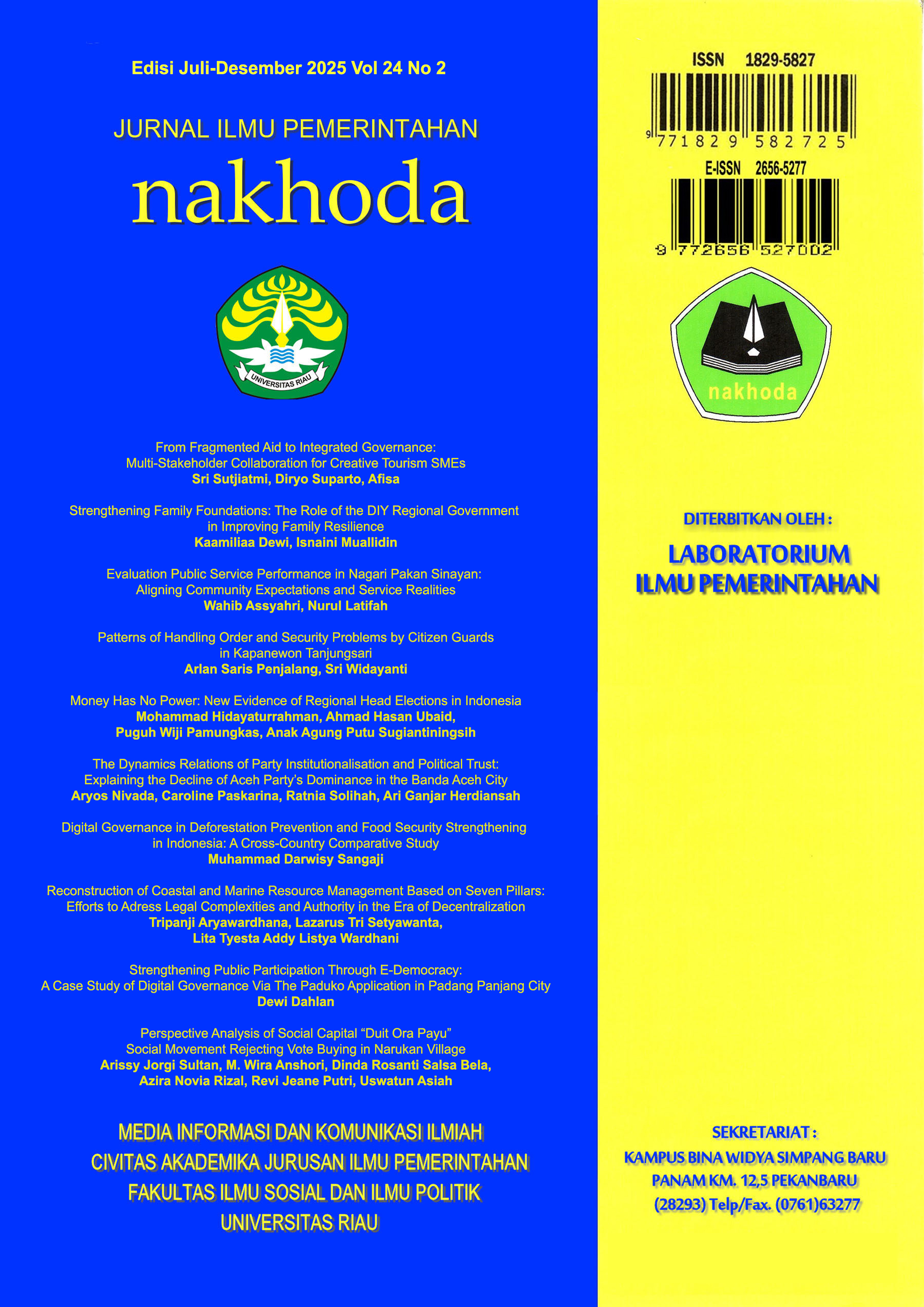
The Dynamics Relations of Party Institutionalisation and Political Trust
Explaining the Decline of Aceh Party’s Dominance in the Banda Aceh City
DOI:
https://doi.org/10.35967/njip.v24i2.891Keywords:
Aceh Party, Political Trust, Party Institutionalism, Legislative PerformanceAbstract
This study explores the reasons behind the decline of the Aceh Party in the Banda Aceh City legislative elections over four election cycles (2009, 2014, 2019 and 2024). After an initial success in 2009 with six seats, the party experienced a gradual decline, losing four seats in 2014, two in 2019, and ultimately losing all representation in 2024. This decline raises questions about the internal and external dynamics that influence the resilience of local parties in the post conflict period. The study employs a neo-institutional framework that combines the concepts of party institutionalization and public trust. The approach used is qualitative, using data collected through in-depth interviews, field observations, and secondary data analysis. The analysis reveals three main findings. First, the ideological foundation of the Aceh Party is increasingly disconnected from the diverse urban population. Second, its legislative performance fails to project a credible image in the performance of its oversight and public representation functions. Third, internal conflict and leadership changes create a fragile and unstable organizational structure. In conclusion, the party's decline is not only due to changing voter preferences but also reflects deeper institutional challenges, the inability to adapt ideology to local realities, maintain organizational coherence, and meet demands for political accountability. These findings emphasize that identity-rooted parties must adapt their historical narratives to contemporary issues and strengthen transparent governance to remain relevant in the competitive political arena.
Downloads
References
Barokah, F., Maryanah, T., Darmastuti, A., & Hertanto, H. (2022). Political Disruption: Opportunities and Challenges of New Political Parties Ahead of the 2024 Election. Nakhoda: Jurnal Ilmu Pemerintahan, 21(1), 1–13. https://doi.org/10.35967/njip.v21i1.273
Barter, S. J. (2015). Between a rock and a hard place: second-order minorities in the Aceh conflict. Asian Ethnicity, 16(2), 152–165. https://doi.org/10.1080/14631369.2015.1003689
Bertsou, E. (2019). Political Distrust and its Discontents: Exploring the Meaning, Expression and Significance of Political Distrust. Societies, 9(4), 72. https://doi.org/10.3390/soc9040072
Bevan, S., Borghetto, E., & Seeberg, H. (2024). Do different parties respond to different problems? A comparative study of parliamentary questions across multiple countries. Journal of European Public Policy, 31(7), 1856–1878. https://doi.org/10.1080/13501763.2023.2193583
Bornman, E. (2022). National pride and identification with national symbols in a divided society: the case of South Africa. Identities, 29(3), 282–300. https://doi.org/10.1080/1070289X.2021.1994227
Braun, V., & Clarke, V. (2019). Reflecting on reflexive thematic analysis. Qualitative Research in Sport, Exercise and Health, 11(4), 589–597. https://doi.org/10.1080/2159676X.2019.1628806
Budiatri, A. P. (2021). The Impact of Local Parties on Party System Institutionalisation in Post-Conflict Aceh. Journal of Current Southeast Asian Affairs, 41(1), 34-58. https://doi.org/10.1177/18681034211029035
Carstens, J. (2023). Unpacking Political Trust: A Review of Conceptualisations, Determinants, and Consequences. French Politics, 21(3), 295–314. https://doi.org/10.1057/s41253-023-00220-5
Casal Bértoa, F. (2017). Political parties or party systems? Assessing the ‘myth’ of institutionalisation and democracy. West European Politics, 40(2), 402–429. https://doi.org/10.1080/01402382.2016.1216921
Ferizaldi. (2017). Patologi Birokrasi Dalam Transformasi Politik Lokal: Tinjauan Terhadap Fenomena "Pajak Nanggroe" di Aceh. Nakhoda: Jurnal Ilmu Pemerintahan, 16(27), 32–39. https://doi.org/10.35967/jipn.v16i27.5793
Fjelde, Hanne. (2020). Political Party Strength and Electoral Violence. Journal of Peace Research, 57(1), 140–55. doi: https://doi.org/10.1177/0022343319885177
Gauja, A., Kosiara-Pedersen, K. (2021). Decline, adaptation and relevance: political parties and their researchers in the twentieth century. European Political Science 20, 123–138. https://doi.org/10.1057/s41304-020-00312-8
Gouglas, A., Katz, G., Maddens, B., & Brans, M. (2020). Transformational party events and legislative turnover in West European democracies, 1945–2015. Party Politics, 27(6), 1211-1222. https://doi.org/10.1177/1354068820944703
Hall, S., & Liebenberg, L. (2024). Qualitative Description as an Introductory Method to Qualitative Research for Master’s-Level Students and Research Trainees. International Journal of Qualitative Methods, 23. https://doi.org/10.1177/16094069241242264
Hasanal Bolqiah, L., & Raffiudin, R. (2020). Oligarchy Domination and The Absence of Green Political Party in Indonesia. Nakhoda: Jurnal Ilmu Pemerintahan, 19(2), 151–167. https://doi.org/10.35967/njip.v19i2.112
Hasanudin. (2019). Peran Partai Politik Dalam Menggerakkan Partisipasi Politik Rakyat. Nakhoda: Jurnal Ilmu Pemerintahan, 17(30):94–100. https://doi.org/10.35967/jipn.v17i30.7062
Hermanto, A., & Laser, N. (2020). The Effect of Trust of a Political Party as a Moderating Variable on the Leadership towards Voters’ Loyalty. Journal of Public Affairs, 20(3). https://doi.org/10.1002/pa.2121
Hetherington, M. J. & Rudolph, T. J. (2015). Why Washington Won’t Work: Polarization, Political Trust, and the Governing Crisis. Chicago Studies in American Politics: University of Chicago Press.
Hooghe, M., Okolikj, M., & Oser, J. (2025). Does party identification still matter for political efficacy? A cross-national assessment, 1996–2016. Contemporary Politics, 31(2), 173–192. https://doi.org/10.1080/13569775.2024.2329396
Hwang, K. (2023). The relevance of neo-institutionalism for organizational change. Cogent Social Sciences, 9(2). https://doi.org/10.1080/23311886.2023.2284239
Ignazi, P. (2014). Power and the (il)legitimacy of political parties: An unavoidable paradox of contemporary democracy? An unavoidable paradox of contemporary democracy? Party Politics, 20(2), 160-169. https://doi.org/10.1177/1354068813519970
Islam, Md. N., Bingöl, Y., Nyadera, I. N., & Dagba, G. (2021). Toward Islam Through Political Parties, Ideology, and Democracy: A Discourse Analysis on Turkey’s AK Party, Tunisian Ennahda, and Bangladesh Jamaat-e-Islami. Jadavpur Journal of International Relations, 25(1), 26-51. https://doi.org/10.1177/09735984211019797
Janah, K., Fatimah, S., & Hariz, H. S. S. (2023). The Role of Aceh Local Parties in The 2024 General Election in Realizing Democratization. Volksgeist: Jurnal Ilmu Hukum Dan Konstitusi, 33–47. https://doi.org/10.24090/volksgeist.v6i1.7532
Kavasoglu, B. (2022). Autocratic Ruling Parties during Regime Transitions: Investigating the Democratizing Effect of Strong Ruling Parties. Party Politics, 28(2):377–88. https://doi.org/10.1177/1354068820985280
Khodijah, S., & Subekti, V. S. (2020). The Dynamics of Coalition Development of Political Parties Supporting Single Candidates for Local Head Election of Lebak Regency in 2018. Nakhoda: Jurnal Ilmu Pemerintahan, 19(2), 177–187. https://doi.org/10.35967/njip.v19i2.111
Kristiyanto, H., Satya, A., & Ghafur, H. S. (2023). Institutionalization and Party Resilience in Indonesian Electoral Democracy. Heliyon, 9(12), e22919. https://doi.org/10.1016/j.heliyon.2023.e22919
Lupu, N. (2014). Brand Dilution and the Breakdown of Political Parties in Latin America. World Politics, 66(4), 561–602. doi: https://doi.org/10.1017/S0043887114000197
Mahmud, R. (2021). What explains citizen trust in public institutions? Quality of government, performance, social capital, or demography. Asia Pacific Journal of Public Administration, 43(2), 106–124. https://doi.org/10.1080/23276665.2021.1893197
Mainwaring, S., & Scully, T. (1995). Building Democratic Institutions?: Party Systems in Latin America. California: Stanford University Press.
Martin, A. R. (2022). This too in moderation: Evaluating the effect of delegate dissatisfaction on ambitious party group switching in the European Parliament. Party Politics, 29(4), 726-740. https://doi.org/10.1177/13540688221096531
Mukhrijal, M., Rassanjani, S., Herizal, H., & Afrijal, A. (2021). The Winning of the Partai Aceh in a Psychological Political Approach. Journal of Governance and Public Policy, 8(2), 140–156. https://doi.org/10.18196/jgpp.v8i2.11586
Murtagh, C., & McCulloch, A. (2021). Beyond the core: Do ethnic parties ‘reach out’ in power-sharing systems? The British Journal of Politics and International Relations, 23(3), 533-551. https://doi.org/10.1177/1369148120973139
Nofriadi., Hasan, E., Rassanjani, S., Helmi., & Afrijal. (2024). Analysis of the Performance of the Election-Winning Agency of the Regional Representative Council of the Indonesian Democratic Party of Struggle in Aceh in Nominating Legislative Candidates for the 2024 Simultaneous General Election. Electronic Journal of Education, Social Economics and Technology, 5(2), 70–78. https://doi.org/10.33122/ejeset.v5i2.237
Norris, P. (2017). The Conceptual Framework of Political Support. 19–32 in Handbook on Political Trust. Edward Elgar Publishing.
Oktavania, D. A., Sutjiatmi, S., & Habibullah, A. (2024). Strategy for the Effectiveness of the PDI Perjuangan KomandanTe Stelsel in Central Java in the 2024 Election. Nakhoda: Jurnal Ilmu Pemerintahan, 23(2), 145–158. https://doi.org/10.35967/njip.v23i2.72
Park, B. B., Leng, T. K., & Wu, K. H. (2022). Politics of urban cultural preservation and regeneration: the case of South Korea and Taiwan. Journal of Contemporary East Asia Studies, 11(2), 300–328. https://doi.org/10.1080/24761028.2023.2176404
Park, J. H. (2021). The Electoral Paradox of Party Institutionalisation: The Case of PKS in Eastern Indonesia. Asian Studies Review, 45(4), 690–710. https://doi.org/10.1080/10357823.2021.1931661
Petrarca, C. S., Giebler, H., & Weßels, B. (2020). Support for insider parties: The role of political trust in a longitudinal-comparative perspective. Party Politics, 28(2), 329-341. https://doi.org/10.1177/1354068820976920
Pratitaswari, A., & Wardani , S. B. E. (2020). The Phenomenon of Political Brokers in Electoral Commision. Nakhoda: Jurnal Ilmu Pemerintahan, 19(2), 217–228. https://doi.org/10.35967/njip.v19i2.106
Randall, V., & Svåsand, L. (2002). Party Institutionalization in New Democracies. Party Politics, 8(1), 5-29. https://doi.org/10.1177/1354068802008001001
Rasmussen MB, Knutsen CH. (2021). Party Institutionalization and Welfare State Development. British Journal of Political Science, 51(3), 1203-1229. https://doi.org/10.1017/S0007123419000498
Ridge, H. M. (2022). Party system institutionalization, partisan affect, and satisfaction with democracy. Party Politics, 29(6), 1013-1023. https://doi.org/10.1177/13540688221130492
Sauerland, D. (2015). Ideologies, Institutions, and the New Institutionalism. 561–72 in International Encyclopedia of the Social & Behavioral Sciences. Elsevier.
Savage, L. (2016). Party System Institutionalization and Government Formation in new Democracies. World Politics, 68(3), 499-537. https://doi.org/10.1017/S0043887115000477
Scarrow, S. E. (2021). Intra-Party Democracy and Party Unity: Varied Rules, Varied Consequences. Representation, 57(1), 41–57. https://doi.org/10.1080/00344893.2020.1785537
Sindre, G. M. (2014). Internal party democracy in former rebel parties. Party Politics, 22(4), 501-511. https://doi.org/10.1177/1354068814550436
Treiber, J. (2025). Expelling controversies: assessing the effectiveness of party expulsion procedures to resolve internal conflicts. European Politics and Society, 26(3), 741–757. https://doi.org/10.1080/23745118.2024.2395840
Tinov, M., & Handoko, T. (2017). Strategi Politik: Preferensi Partai Politik Menghadapi Pemilu di Aras Lokal. Nakhoda: Jurnal Ilmu Pemerintahan, 15(25), 53–64. https://doi.org/10.35967/jipn.v15i25.3855
Weeks, A. C., & Allen, P. (2023). Backlash against “identity politics”: far right success and mainstream party attention to identity groups. Politics, Groups, and Identities, 11(5), 935–953. https://doi.org/10.1080/21565503.2022.2065318
Weinberg, J. (2023). Building Trust in Political Office: Testing the Efficacy of Political Contact and Authentic Communication. Political Studies, 72(4), 1288-1312. https://doi.org/10.1177/00323217231185706
Winsvold, M., Haugsgjerd, A., Saglie, J., & Segaard, S. B. (2024). What makes people trust or distrust politicians? Insights from open-ended survey questions. West European Politics, 47(4), 759–783. https://doi.org/10.1080/01402382.2023.2268459
Zulfan, Z., Ikramatoun, S., & Aminah, A. (2023). Aceh Local Political Party: The Rise, Victory, and Decline.Multidisciplinary Science Journal, 5:e2023018. doi: https://doi.org/10.31893/multiscience.2023018
Downloads
Published
How to Cite
Issue
Section
License
Copyright (c) 2025 Authors

This work is licensed under a Creative Commons Attribution-NonCommercial-ShareAlike 4.0 International License.