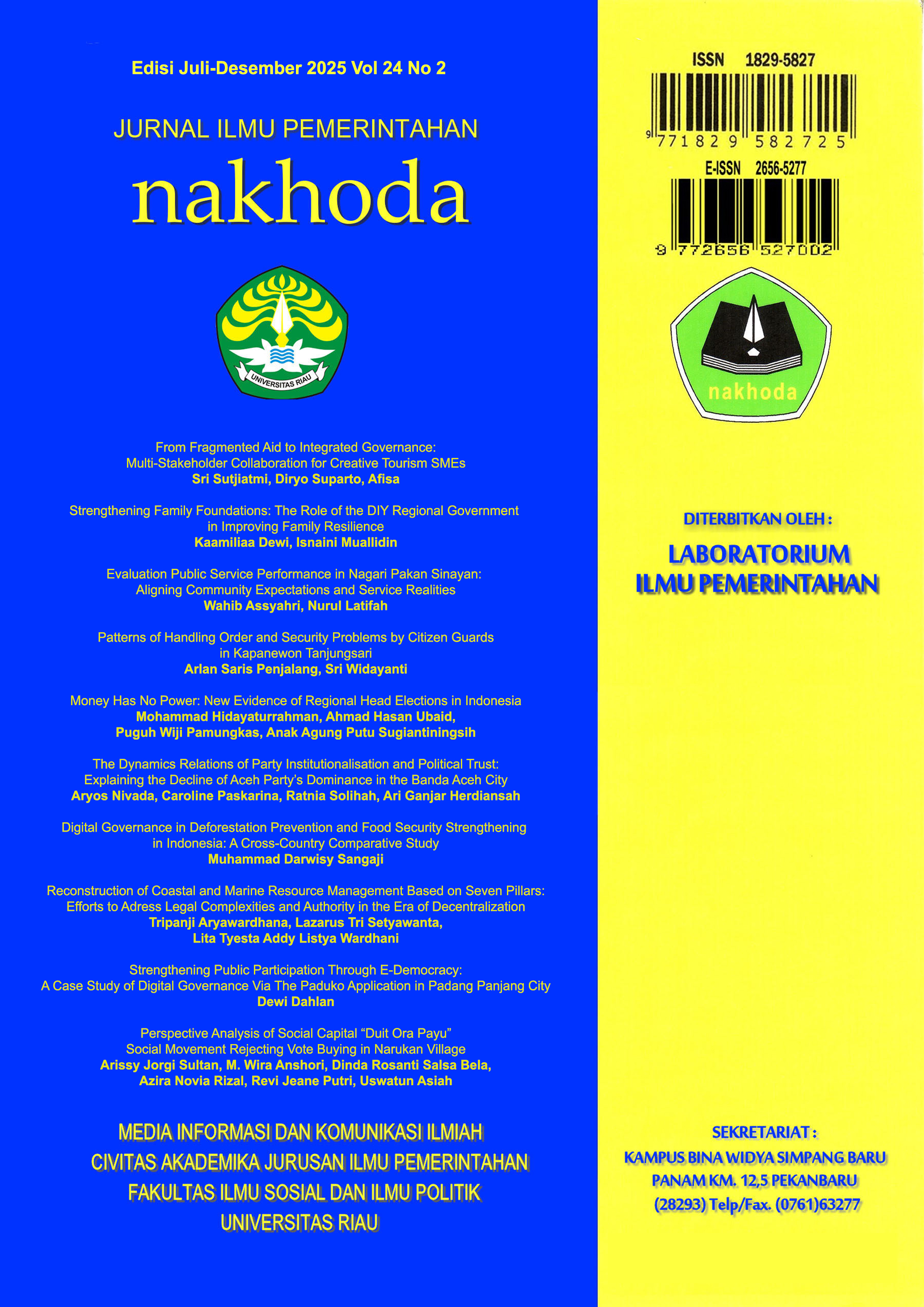
Penguatan Partisipasi Publik melalui E-Demokrasi
Studi Kasus Tata Kelola Digital melalui Aplikasi PADUKO di Kota Padang Panjang
DOI:
https://doi.org/10.35967/njip.v24i2.886Kata Kunci:
E-demokrasi, Pemerintahan Digital, Partisipasi MasyarakatAbstrak
Perkembangan pesat teknologi informasi dan komunikasi telah memperluas peluang bagi pemerintah untuk mendorong tata kelola pemerintahan yang partisipatif, transparan, dan akuntabel melalui edemokrasi. Penelitian ini menganalisis implementasi aplikasi PADUKO (Pelayanan Administrasi Kependudukan Online) sebagai bentuk tata kelola digital dan e-demokrasi di Kota Padang Panjang. Penelitian ini menggunakan studi kasus evaluatif dengan pendekatan kualitatif. Data dikumpulkan melalui wawancara mendalam, observasi, dan analisis dokumen, serta divalidasi melalui triangulasi sumber dan diskusi kelompok terfokus (FGD). Hasil penelitian menunjukkan bahwa PADUKO meningkatkan transparansi layanan, akses informasi digital, partisipasi masyarakat, serta kolaborasi antarperangkat daerah dalam pelayanan administrasi kependudukan. Namun demikian, partisipasi masyarakat masih bersifat prosedural dan konsultatif, yang berada pada tingkat konsultasi dan peredaman (placation) dalam tangga partisipasi Arnstein. Tantangan seperti kesenjangan literasi digital, keterbatasan infrastruktur, dan rendahnya pemerataan kesadaran publik masih membatasi keterlibatan masyarakat yang bermakna. Penelitian ini menyimpulkan bahwa efektivitas inisiatif edemokrasi tidak hanya ditentukan oleh kesiapan teknologi, tetapi juga oleh dukungan kelembagaan dan keterlibatan aktif masyarakat untuk mencapai pemberdayaan warga yang substantif dalam tata kelola pemerintahan lokal.
Unduhan
Referensi
Ariawan., Soemartono, T., Effendy, K., & Sukmana, P. (2025). Citizen engagement in democratic
governance: Insights from participatory policy-making. Politeia: Journal of Public Administration and
Political Science and International Relations, 3(4), 286–298. https://doi.org/10.61978/politeia.v3i4.965
Arnstein, S. R. (1969). A ladder of citizen participation. Journal of the American Institute of Planners, 35(4), 216–224. https://doi.org/10.1080/01944366908977225
Bertot, J. C., Jaeger, P. T., & Grimes, J. M. (2010). Using ICTs to create a culture of transparency: Egovernment and social media as openness and anti-corruption tools for societies. Government Information Quarterly, 27(3), 264–271. https://doi.org/10.1016/j.giq.2010.03.001
Dawes, S. S. (2009). Governance in the digital age: A research and action framework for an uncertain future. Government Information Quarterly, 26(2), 257–264. https://doi.org/10.1016/j.giq.2008.12.003
Dwiputrianti, S. (2018). Building local government capacity for e-governance in Indonesia. Asian Journal of Political Science, 26(1), 49–68. https://doi.org/10.1080/02185377.2018.1448732
Fung, A. (2006) Varieties of Participation in Complex Governance. Public Administration Review, 66, 66-75. https://doi.org/10.1111/j.1540-6210.2006.00667.x
Gil-Garcia, J. R., Helbig, N., & Ojo, A. (2014). Being smart: Emerging technologies and innovation in the public sector. Government Information Quarterly, 31(Supplement 1), I1–I8. https://doi.org/10.1016/j.giq.2014.09.001
Handayani, P. W., Hidayanto, A. N., & Sandhyaduhita, P. I. (2015). Strategic e-government evaluation: A literature review and future research directions. Information Development, 31(3), 194–208. https://doi.org/10.1177/0266666913515480
Jaeger, P. T., & Thompson, K. M. (2003). E-government around the world: Lessons, challenges, and future directions. Government Information Quarterly, 20(4), 389–394.
Janssen, M., Charalabidis, Y., & Zuiderw?k, A. (2012). Benefits, adoption barriers and myths of open data and open government. Information Systems Management, 29(4), 258–268. https://doi.org/10.1080/10580530.2012.716740
Me?er, A. J., Curtin, D., & Hillebrandt, M. (2012). Open government: Connecting vision and voice. International Review of Administrative Sciences, 78(1), 10–29. https://doi.org/10.1177/0020852311429533
Moon, M. J. (2002). The evolution of e-government among municipalities: Rhetoric or reality?. Public Administration Review, 62(4), 424–433. https://doi.org/10.1111/0033-3352.00196
Nugroho, Y. (2011). Citizens in @action: Collaboration, participatory democracy and freedom of information–Mapping contemporary civic activism and the use of new social media in Indonesia. University of Manchester and HIVOS Regional Office Southeast Asia.
OECD. (2018). Open government: The global context. OECD Publishing.
Prabowo, H., & Nugraha, E. (2017). E-participation and digital divide in Indonesia: A case of Jakarta Smart City. Journal of e-Government Studies and Best Practices, 2017, 1–9. https://doi.org/10.5171/2017.891752
Prastya, D. E., Misran, & Nurmandi, A. (2021). A bibliometric analysis of e-democracy on government research. Jurnal Ilmiah Mimbar Demokrasi, 20(2), 71–80. https://doi.org/10.21009/jimd.v20i2.19772
Pratama, D., Haryati, E., & Ferriswara, D. (2025). Digitization of population administration services: Analysis of the need to improve digital literacy of village government apparatus. Parlementer: Jurnal Studi Hukum dan Administrasi Publik, 2(1), 26–39. https://doi.org/10.62383/parlementer.v2i1.507
Suria, O., Prasetyaningrum, P. T., & Pratama, I. (2025). Digital transformation of population administration: Enhancing data accessibility in local communities. Abdimas: Jurnal Pengabdian Masyarakat Universitas Merdeka Malang, 10(1), 92–103. https://doi.org/10.26905/abdimas.v10i1.14983
Susniwati, S., Kurniawati, K., & Susilawati, S. (2024). Public policy innovation in Indonesia: Enhancing citizen engagement through e-government initiatives. PINISI Discretion Review, 8(1), 45–60. https://doi.org/10.26858/pdr.v8i1.66364
Sutrisna, F. H., Nugroho, D. Y., & Ta Rebo, E. (2024). The development of digital democracy in Indonesia: A case study of online election platforms. LAW & PASS: International Journal of Law, Public Administration and Social Studies, 1(3), 374–382. https://doi.org/10.47353/lawpass.v1i3.35
United Nations Department of Economic and Social Affairs. (2020). United Nations E-Government Survey 2020: Digital government in the decade of action for sustainable development (Full report). United Nations. https://publicadministration.un.org/egovkb/Portals/egovkb/Documents/un/2020-Survey/2020%20UN%20E-Government%20Survey%20(Full%20Report).pdf
Wirtz, B. W., & Daiser, P. (2015). E-Government: Strategy process instruments. ISBN 978-3-00-050445-7
Unduhan
Diterbitkan
Cara Mengutip
Terbitan
Bagian
Lisensi
Hak Cipta (c) 2026 Dewi Dahlan

Artikel ini berlisensiCreative Commons Attribution-NonCommercial-ShareAlike 4.0 International License.